Saturday, 19 November 2016

Comparison with vacuum tubes

Before transistors were developed, vacuum (electron) tubes (or in the UK "thermionic valves" or just "valves") were the main active components in electronic equipment.

Image result for Transistor

Advantages[edit]

The key advantages that have allowed transistors to replace vacuum tubes in most applications are
  • no cathode heater (which produces the characteristic orange glow of tubes), reducing power consumption, eliminating delay as tube heaters warm up, and immune from cathode poisoning and depletion;
  • very small size and weight, reducing equipment size;
  • large numbers of extremely small transistors can be manufactured as a single integrated circuit;
  • low operating voltages compatible with batteries of only a few cells;
  • circuits with greater energy efficiency are usually possible. For low-power applications (e.g., voltage amplification) in particular, energy consumption can be very much less than for tubes;
  • inherent reliability and very long life; tubes always degrade and fail over time. Some transistorized devices have been in service for more than 50 years[citation needed] ;
  • complementary devices available, providing design flexibility including complementary-symmetry circuits, not possible with vacuum tubes;
  • very low sensitivity to mechanical shock and vibration, providing physical ruggedness and virtually eliminating shock-induced spurious signals (e.g., microphonics in audio applications);
  • not susceptible to breakage of a glass envelope, leakage, outgassing, and other physical damage.

Limitations

Transistors have the following limitations:
  • silicon transistors can age and fail;
  • high-power, high-frequency operation, such as that used in over-the-air television broadcasting, is better achieved in vacuum tubes due to improved electron mobility in a vacuum;
  • solid-state devices are susceptible to damage from very brief electrical and thermal events, including electrostatic discharge in handling; vacuum tubes are electrically much more rugged;
  • sensitivity to radiation and cosmic rays (special radiation-hardened chips are used for spacecraft devices);
  • vacuum tubes in audio applications create significant lower-harmonic distortion, the so-called tube sound, which some people prefer

Transitor as an amplifier

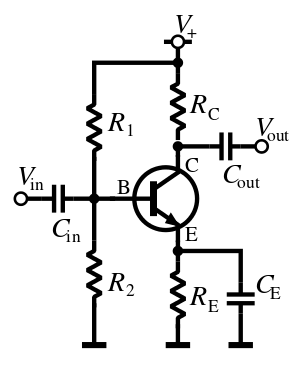
The common-emitter amplifier is designed so that a small change in voltage (Vin) changes the small current through the base of the transistor; the transistor's current amplification combined with the properties of the circuit mean that small swings in Vin produce large changes in Vout.
Various configurations of single transistor amplifier are possible, with some providing current gain, some voltage gain, and some both.

Image result for Transistor

From mobile phones to televisions, vast numbers of products include amplifiers for sound reproductionradio transmission, and signal processing. The first discrete-transistor audio amplifiers barely supplied a few hundred milliwatts, but power and audio fidelity gradually increased as better transistors became available and amplifier architecture evolved.
Modern transistor audio amplifiers of up to a few hundred watts are common and relatively inexpensive.


Transistor as switch

Transistors are commonly used in digital circuits as electronic switches which can be either in an "on" or "off" state, both for high-power applications such as switched-mode power supplies and for low-power applications such as logic gates. Important parameters for this application include the current switched, the voltage handled, and the switching speed, characterised by the rise and fall times.
In a grounded-emitter transistor circuit, such as the light-switch circuit shown, as the base voltage rises, the emitter and collector currents rise exponentially. The collector voltage drops because of reduced resistance from collector to emitter. If the voltage difference between the collector and emitter were zero (or near zero), the collector current would be limited only by the load resistance (light bulb) and the supply voltage. This is called saturation because current is flowing from collector to emitter freely. When saturated, the switch is said to be on.[34]
Providing sufficient base drive current is a key problem in the use of bipolar transistors as switches. The transistor provides current gain, allowing a relatively large current in the collector to be switched by a much smaller current into the base terminal. The ratio of these currents varies depending on the type of transistor, and even for a particular type, varies depending on the collector current. In the example light-switch circuit shown, the resistor is chosen to provide enough base current to ensure the transistor will be saturated.
In a switching circuit, the idea is to simulate, as near as possible, the ideal switch having the properties of open circuit when off, short circuit when on, and an instantaneous transition between the two states. Parameters are chosen such that the "off" output is limited to leakage currents too small to affect connected circuitry; the resistance of the transistor in the "on" state is too small to affect circuitry; and the transition between the two states is fast enough not to have a detrimental effect

Operation of transistor

The essential usefulness of a transistor comes from its ability to use a small signal applied between one pair of its terminals to control a much larger signal at another pair of terminals. This property is called gain. It can produce a stronger output signal, a voltage or current, which is proportional to a weaker input signal; that is, it can act as an amplifier. Alternatively, the transistor can be used to turn current on or off in a circuit as an electrically controlled switch, where the amount of current is determined by other circuit elements.


There are two types of transistors, which have slight differences in how they are used in a circuit. A bipolar transistor has terminals labeled basecollector, and emitter. A small current at the base terminal (that is, flowing between the base and the emitter) can control or switch a much larger current between the collector and emitter terminals. For a field-effect transistor, the terminals are labeled gatesource, and drain, and a voltage at the gate can control a current between source and drain.
The image represents a typical bipolar transistor in a circuit. Charge will flow between emitter and collector terminals depending on the current in the base. Because internally the base and emitter connections behave like a semiconductor diode, a voltage drop develops between base and emitter while the base current exists. The amount of this voltage depends on the material the transistor is made from, and is referred to as VBE.

Importance of transistor


The transistor is the key active component in practically all modern electronics. Many consider it to be one of the greatest inventions of the 20th century.[29] Its importance in today's society rests on its ability to be mass-produced using a highly automated process (semiconductor device fabrication) that achieves astonishingly low per-transistor costs. The invention of the first transistor at Bell Labs was named an IEEE Milestone in 2009.[30]
Although several companies each produce over a billion individually packaged (known as discrete) transistors every year,[31] the vast majority of transistors are now produced in integrated circuits (often shortened to ICmicrochips or simply chips), along with diodesresistorscapacitors and other electronic components, to produce complete electronic circuits. A logic gate consists of up to about twenty transistors whereas an advanced microprocessor, as of 2009, can use as many as 3 billion transistors (MOSFETs).[32] "About 60 million transistors were built in 2002… for [each] man, woman, and child on Earth."[33]
The transistor's low cost, flexibility, and reliability have made it a ubiquitous device. Transistorized mechatronic circuits have replaced electromechanical devices in controlling appliances and machinery. It is often easier and cheaper to use a standard microcontroller and write a computer program to carry out a control function than to design an equivalent mechanical control function

Darlington transistor opened up so the actual transistor chip (the small square) can be seen inside. A Darlington transistor is effectively two transistors on the same chip. One transistor is much larger than the other, but both are large in comparison to transistors in large-scale integration because this particular example is intended for power applications.

History of transistor


A replica of the first working transistor.
The thermionic triode, a vacuum tube invented in 1907, enabled amplified radio technology and long-distance telephony. The triode, however, was a fragile device that consumed a lot of power. Physicist Julius Edgar Lilienfeld filed a patent for a field-effect transistor (FET) in Canada in 1925, which was intended to be a solid-state replacement for the triode.[4][5] Lilienfeld also filed identical patents in the United States in 1926[6] and 1928.[7][8]However, Lilienfeld did not publish any research articles about his devices nor did his patents cite any specific examples of a working prototype. Because the production of high-quality semiconductor materials was still decades away, Lilienfeld's solid-state amplifier ideas would not have found practical use in the 1920s and 1930s, even if such a device had been built.[9] In 1934, German inventor Oskar Heil patented a similar device in Europe.[10]
From November 17, 1947 to December 23, 1947, John Bardeen and Walter Brattain at AT&T's Bell Labs in the United States performed experiments and observed that when two gold point contacts were applied to a crystal of germanium, a signal was produced with the output power greater than the input.[11] Solid State Physics Group leader William Shockley saw the potential in this, and over the next few months worked to greatly expand the knowledge of semiconductors. The term transistor was coined by John R. Pierce as a contraction of the term transresistance.[12][13][14] According to Lillian Hoddeson and Vicki Daitch, authors of a biography of John Bardeen, Shockley had proposed that Bell Labs' first patent for a transistor should be based on the field-effect and that he be named as the inventor. Having unearthed Lilienfeld’s patents that went into obscurity years earlier, lawyers at Bell Labs advised against Shockley's proposal because the idea of a field-effect transistor that used an electric field as a "grid" was not new. Instead, what Bardeen, Brattain, and Shockley invented in 1947 was the first point-contact transistor.[9] In acknowledgement of this accomplishment, Shockley, Bardeen, and Brattain were jointly awarded the 1956 Nobel Prize in Physics "for their researches on semiconductors and their discovery of the transistor effect."[15]
Herbert F. Mataré (1950)
In 1948, the point-contact transistor was independently invented by German physicists Herbert Mataré and Heinrich Welker while working at the Compagnie des Freins et Signaux, a Westinghouse subsidiary located in Paris. Mataré had previous experience in developing crystal rectifiers from silicon and germanium in the German radar effort during World War II. Using this knowledge, he began researching the phenomenon of "interference" in 1947. By June 1948, witnessing currents flowing through point-contacts, Mataré produced consistent results using samples of germanium produced by Welker, similar to what Bardeen and Brattain had accomplished earlier in December 1947. Realizing that Bell Labs' scientists had already invented the transistor before them, the company rushed to get its "transistron" into production for amplified use in France's telephone network.[16]
Philco surface-barrier transistor developed and produced in 1953
The first high-frequency transistor was the surface-barrier germanium transistordeveloped by Philco in 1953, capable of operating up to 60 MHz.[17] These were made by etching depressions into an N-type germanium base from both sides with jets of Indium(III) sulfate until it was a few ten-thousandths of an inch thick. Indium electroplated into the depressions formed the collector and emitter.[18][19]
The first "prototype" pocket transistor radio was shown by INTERMETALL (a company founded by Herbert Mataréin 1952) at the Internationale Funkausstellung Düsseldorfbetween August 29, 1953 and September 9, 1953.[20]
The first "production" all-transistor car radio was produced in 1955 by Chrysler and Philco, had used surface-barrier transistors in its circuitry and which were also first suitable for high-speed computers.[21][22][23][24]
The first working silicon transistor was developed at Bell Labs on January 26, 1954 by Morris Tanenbaum. The first commercial silicon transistor was produced by Texas Instruments in 1954. This was the work of Gordon Teal, an expert in growing crystals of high purity, who had previously worked at Bell Labs.[25][26][27] The first MOS transistor actually built was by Kahng and Atalla at Bell Labs in 1960.[28]

About transistor

                                                         Image result for Transistor

transistor is a semiconductor device used to amplify or switch electronic signals and electrical power. It is composed of semiconductor material usually with at least three terminals for connection to an external circuit. A voltage or current applied to one pair of the transistor's terminals controls the current through another pair of terminals. Because the controlled (output) power can be higher than the controlling (input) power, a transistor can amplify a signal. Today, some transistors are packaged individually, but many more are found embedded in integrated circuits.

                                                              Image result for Transistor
The transistor is the fundamental building block of modern electronic devices, and is ubiquitous in modern electronic systems. Julius Lilienfeld patented a field-effect transistor in 1926[1] but it was not possible to actually construct a working device at that time. The first practically implemented device was a point-contact transistor invented in 1947 by American physicists John BardeenWalter Brattain, and William Shockley. The transistor revolutionized the field of electronics, and paved the way for smaller and cheaper radioscalculators, and computers, among other things. The transistor is on the list of IEEE milestones in electronics,[2] and Bardeen, Brattain, and Shockley shared the 1956 Nobel Prize in Physics for their achievement.[3]